From 429s to Guardrails: Making OpenClaw Rate-Limit Aware
A blameless write-up of a March 2026 API rate-limit incident — what happened, what we changed immediately, and the guardrails we’re building so background traffic can’t starve customer workflows.
From 429s to Guardrails: Making OpenClaw Rate-Limit Aware
March 2026

Executive summary (TL;DR)
Earlier this week we saw a spike in API failures while running internal OpenClaw workflows:
- The errors were primarily HTTP
429rate limit errors from Anthropic (Claude), plus occasional overloaded responses. - The trigger was self-inflicted: we expanded background “heartbeat” traffic across our agent fleet and routed more of that traffic through the same constrained provider path.
- Retries amplified the burst, making the system “louder” exactly when the provider was saying “slow down.”
- We mitigated quickly by reducing heartbeat scope and rerouting heartbeat traffic so it could not contend with interactive/customer-facing workflows.
Most importantly: this incident did not change our view of any specific provider. It reinforced a systems truth:
Rate limits aren’t a bug. They’re a design constraint. Your orchestration needs to treat them like gravity.

Rate limits, explained (in one minute)
A rate limit is a provider’s way of keeping a shared system stable. Think of it like a freeway metering light:
- You can still reach your destination.
- But you can’t send unlimited cars onto the on-ramp all at once.
For LLM systems, this becomes especially important because:
- You often have multiple workers (agents, background jobs, retries).
- They often share a single account/key (which is where rate limits are enforced).
- Without coordination, independent “good” behavior becomes a traffic jam.
What happened (sanitized timeline)
We’re intentionally keeping exact timestamps and internal identifiers out of this post. The sequence is what matters.
- A configuration change routed more background work (heartbeats + some background jobs) through Anthropic by default.
- We enabled heartbeats broadly across our agent fleet (roughly two dozen agents).
- Many of those agents shared the same provider key, so independent request streams collapsed into one shared rate limit bucket.
- When 429s started, retry behavior compounded the load, producing bursts.
- We mitigated by reducing heartbeat scope and rerouting heartbeat traffic.
sequenceDiagram
  autonumber
  participant A as Agents (background + interactive)
  participant L as Shared limit bucket (one provider key)
  participant P as Provider API

  A->>P: Requests ramp up (heartbeats enabled broadly)
  P-->>A: 429 rate_limit_error
  A->>P: Retries (not yet jittered/centralized)
  P-->>A: More 429s / occasional overloaded
  note over A,L: Aggregate load concentrates on one key
  A->>L: Mitigation: reduce heartbeat scope
  A->>P: Reroute heartbeat traffic
  P-->>A: Error rate stabilizes
Root cause (blameless)
This was a coordination failure across defaults, fanout, and retries.
1) Defaults moved background traffic onto a single provider
The routing change was reasonable in isolation. The unintended effect was that a high-frequency, low-value workload (heartbeats) began competing for the same constrained capacity as more important tasks.
2) Fanout: “small” heartbeats aren’t small at fleet scale
A heartbeat is cheap. Twenty-something heartbeats on a schedule are not.
This is a classic multi-agent trap: the unit cost is low, so the system feels safe — until you multiply it by concurrency.
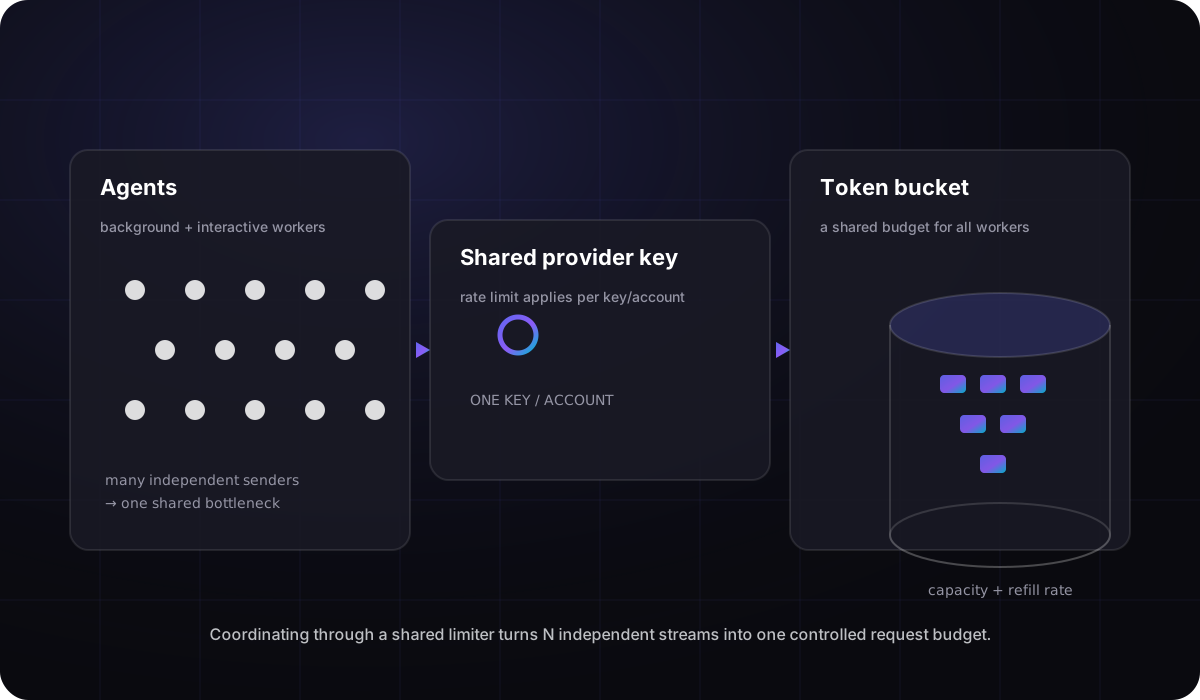
3) Shared provider keys collapse concurrency into one bottleneck
Rate limits are usually applied per key/account. When many workloads share a key, you don’t have “N clients.” You have one client with N sources of demand.
4) Retries are traffic
Retries are essential for resilience, but only when they’re coordinated and backoff-aware.
If each worker retries independently (especially at similar intervals), you get a thundering herd:
- Fail — retry — fail — retry
- …while also starving other, more important tasks
What we changed immediately
We shipped pragmatic mitigations that reduced load quickly:
-
Reduced heartbeat scope
We disabled heartbeats for most agents and kept them only where they were operationally useful. -
Rerouted heartbeat traffic away from the constrained path
Heartbeat traffic moved to a separate provider/model route so a high-frequency background signal could not contend with interactive capacity.
These changes made the system stable again — but they’re not the end state.
The fix we’re building (the guardrails)
The goal isn’t “never hit a rate limit.” The goal is:
- stay within limits automatically
- degrade gracefully when limits change
- protect customer-facing workflows from background noise
Here are the guardrails we’re rolling out in OpenClaw:
1) A global, key-aware rate limiter
Instead of each agent “trying its best,” we enforce a shared budget across all workers using the same provider identity.
flowchart LR
  A[Interactive sessions] --> Q[Queue + concurrency cap]
  B[Background jobs (heartbeats)] --> Q
  Q --> R[Global limiter (per provider key)]
  R --> P[Provider API]
2) Backoff + jitter as a deploy gate (not a suggestion)
When we see 429s, we back off and add jitter so retries disperse over time.
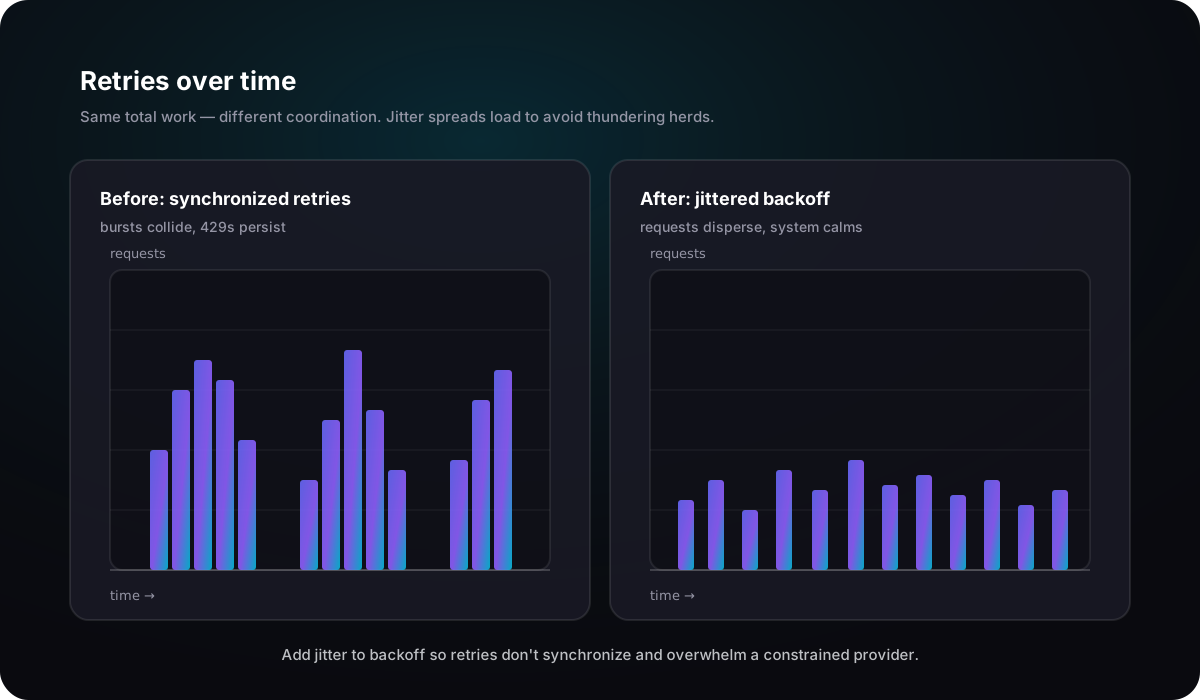
Good retry behavior is reliability engineering, not heroics.
3) Priority lanes (interactive > background)
If a provider is constrained, we should still serve the tasks users notice first:
- interactive sessions
- customer workflows
- time-sensitive actions
Heartbeats should be the first thing to slow down.
4) Workload-aware model routing
We want the flexibility to route by workload type:
- background signals to a cheaper/less constrained path
- high-value tasks to the best model that’s currently available
What this means for customers (and for GTM)
This incident happened in internal workflows, but the takeaway is customer-facing:
- Rate limits can surface at any time as usage grows.
- The right response is not “hope we don’t hit them,” but to build systems that treat them as normal.
The story to tell:
- We hit a predictable scaling boundary.
- We mitigated quickly.
- We’re shipping guardrails that make this class of failure much harder to repeat.
Lessons learned
- Defaults are production decisions. A default routing change can move a surprising amount of traffic.
- Shared keys are shared infrastructure. Treat them like a finite resource.
- Retries must be centralized. Otherwise they amplify exactly when you need calm.
- Background signals must be isolated. Heartbeats should never crowd out real work.
- Multi-agent systems need traffic shaping. Without it, fanout becomes fragility.
If you’re building agent systems: steal these checks
- Do you have a global limiter per provider key?
- Do you have jittered exponential backoff on 429s?
- Do you have priority lanes for interactive traffic?
- Can you reroute a workload class in minutes?
If not, you’ll eventually learn these lessons the same way we did.
Want help implementing rate-limit aware orchestration? Ncubelabs builds production agent systems and the operational guardrails around them. Book a call from the author card below.